
Document the relationship
Select the intended biological relationship. Keep the sample roles and the alternative hypothesis explicit.
FAMILY CONNECTIONS
Explore sibling, avuncular and grandparent relationships using stated hypotheses, appropriate population data and a traceable review.
THE QUESTION
A STRUCTURED PATH
Select the intended biological relationship. Keep the sample roles and the alternative hypothesis explicit.
Review the marker panel, source quality and frequency coverage. Investigate incompatible or unresolved calls.
Read the selected model and its assumptions. Keep a relationship-specific index separate from an identification or reporting decision.
WALK THROUGH AN EXAMPLE
The training compares two synthetic profiles under different relationship modes. Full-sibling, half-sibling, avuncular and grandparent hypotheses are distinct comparisons. The largest number is not a rule for choosing the biological relationship.
Watch this research exampleA FLAG HAS A MEANING
An unresolved call, absent population frequency or unsupported model scope remains visible in the review.
Synthetic examples explain the interface and review logic. Their numbers are not performance claims.
UNDERSTAND THE SCOPE
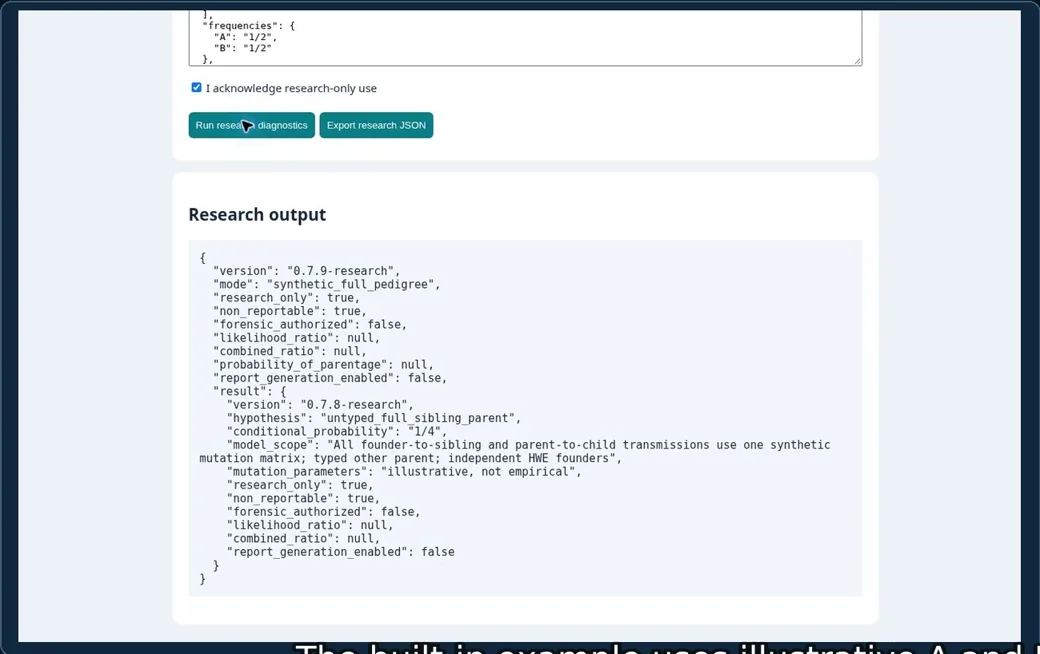
The legacy pedigree example uses illustrative alleles and a synthetic mutation matrix. Its conditional probability is a research diagnostic, not a combined multi-locus LR or a parentage conclusion.
Explore the scientific evaluation frameworkTraining examples use synthetic data and research models. Interpretations and reporting authorization depend on the release, validation scope and laboratory procedures.
LET’S TALK SCIENCE
Describe your laboratory’s platform, intended use and the questions you want to discuss.