
Set the sample roles
Choose the relationship and assign the child, alleged parent and, where relevant, the other parent. Confirm provenance before comparison.
BIOLOGICAL RELATIONSHIPS
Compare child and parent profiles, examine each STR marker and review the evidence behind a research relationship index.
THE QUESTION
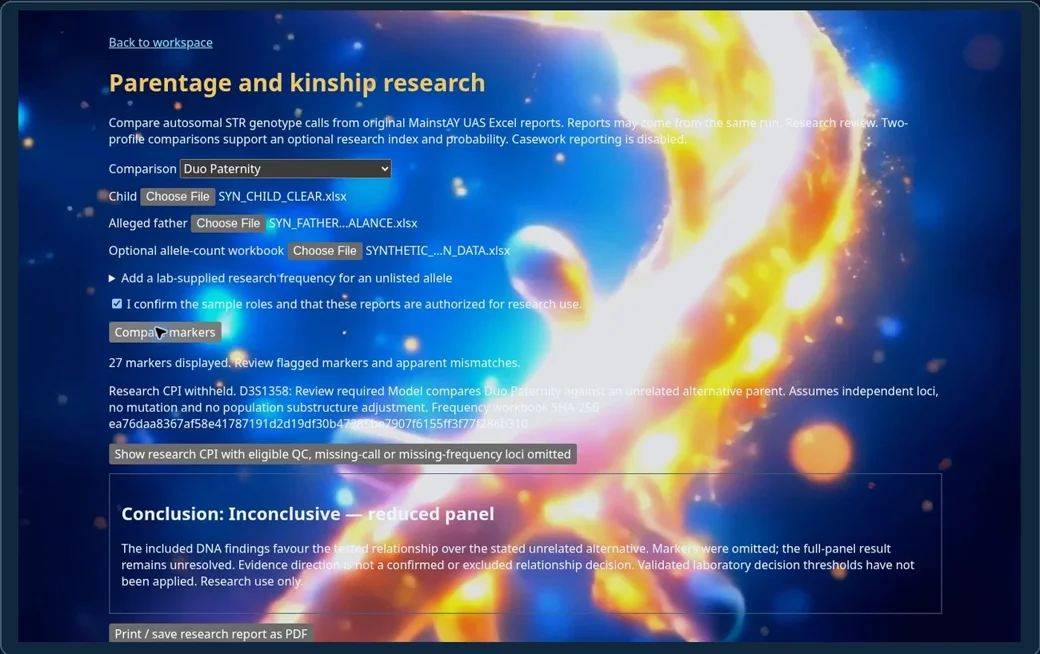
A STRUCTURED PATH
Choose the relationship and assign the child, alleged parent and, where relevant, the other parent. Confirm provenance before comparison.
Examine exported calls, typed status, sequences and read support. Record a supported decision with the reviewer name and confirmation.
Review the included panel, population reference, assumptions and outstanding holds. Preserve the source and decision history.
WALK THROUGH AN EXAMPLE
The synthetic D5S818 exercise distinguishes a reported typed allele from a low-level untyped candidate. “Reject stutter · include signal” retains the reviewed signal; “Accept stutter · exclude signal” removes it. The reviewer checks the source evidence before choosing.
Watch this research exampleA FLAG HAS A MEANING
The full research CPI remains pending until the relevant blockers are resolved. A reduced-panel result must list its omissions.
Synthetic examples explain the interface and review logic. Their numbers are not performance claims.
UNDERSTAND THE SCOPE
Two-profile comparisons can show a research index when supported by the inputs and supplied frequencies. The trio screen in this training release provides marker review without a numeric trio index.
Explore the scientific evaluation frameworkTraining examples use synthetic data and research models. Interpretations and reporting authorization depend on the release, validation scope and laboratory procedures.
LET’S TALK SCIENCE
Describe your laboratory’s platform, intended use and the questions you want to discuss.