
Register the case
Use specimen identifiers and source or custody references. Assign each reference once in the correct role.
IDENTITY AND FAMILY REFERENCES
Organize an unidentified profile, direct reference material and documented biological relatives in one research case workflow.
THE QUESTION
A STRUCTURED PATH
Use specimen identifiers and source or custody references. Assign each reference once in the correct role.
Record the actual QC review and the documented biological relationships. Supply an appropriate population table for numeric comparisons.
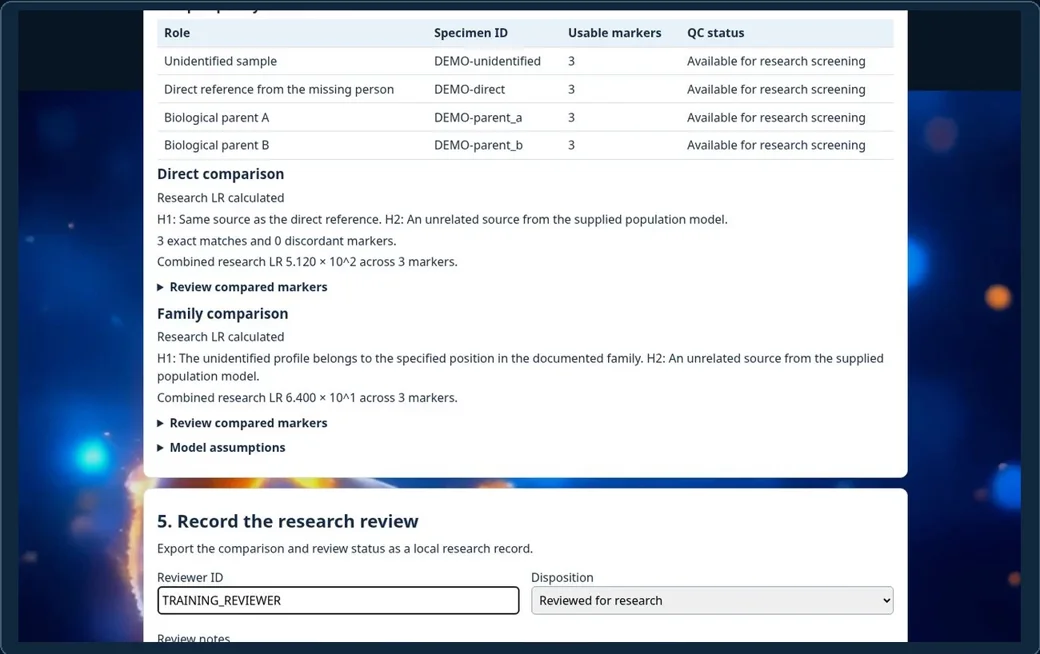
Examine direct and family comparisons separately, record the research disposition and retain the case JSON.
WALK THROUGH AN EXAMPLE
The built-in synthetic example contains an unidentified profile, a direct reference and two biological parents. Changing the unidentified sample to “Pending or held” places both comparisons on QC hold.
Watch this research exampleA FLAG HAS A MEANING
Pending QC, discordant direct calls, incompatible family calls or absent frequencies require investigation before a numeric result can be interpreted.
Synthetic examples explain the interface and review logic. Their numbers are not performance claims.
UNDERSTAND THE SCOPE
Direct concordance, a family research LR and an identification decision are different outputs. The synthetic three-marker exercise demonstrates the interface; it is not identification evidence.
Explore the scientific evaluation frameworkTraining examples use synthetic data and research models. Interpretations and reporting authorization depend on the release, validation scope and laboratory procedures.
LET’S TALK SCIENCE
Describe your laboratory’s platform, intended use and the questions you want to discuss.